
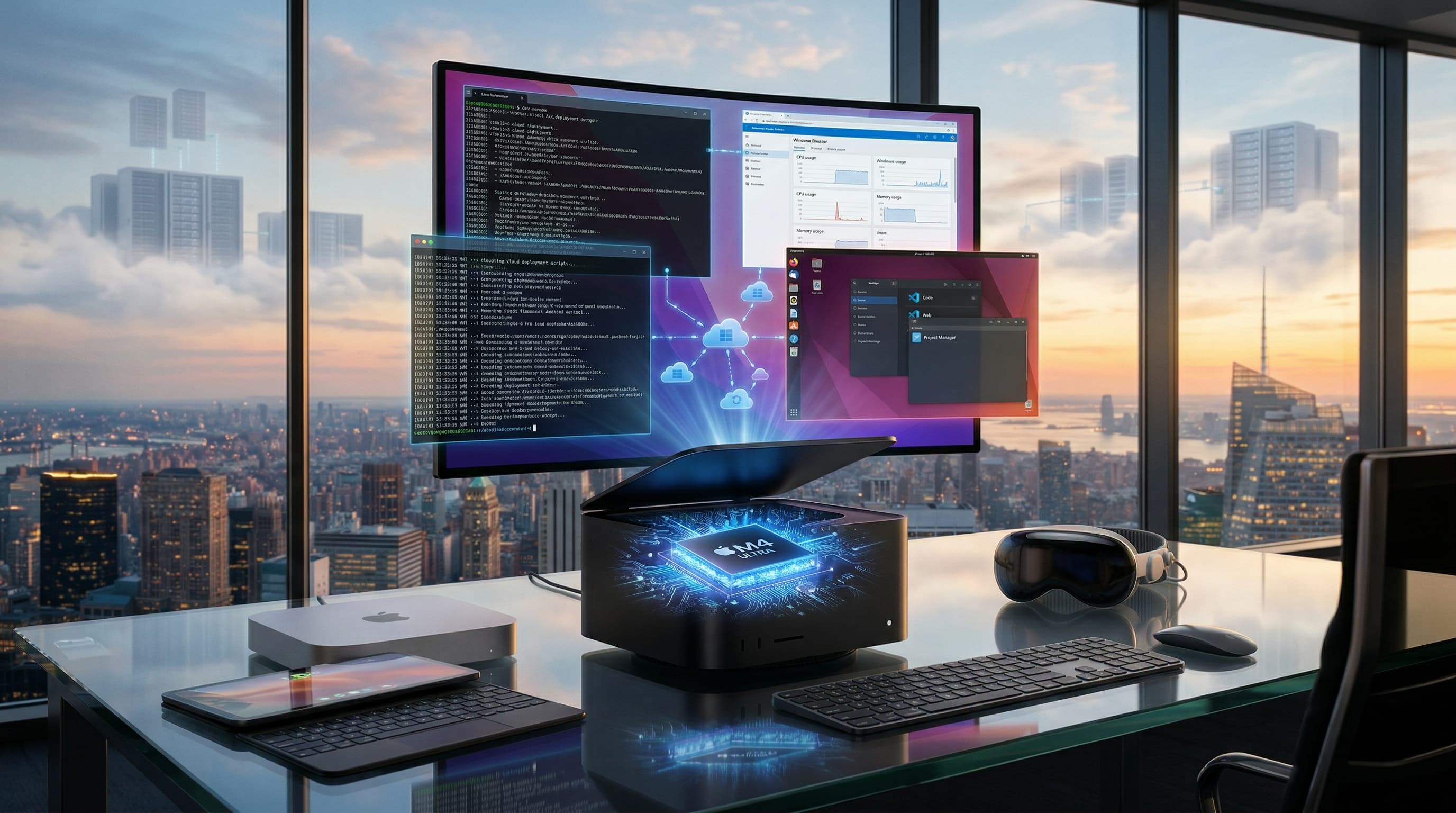
Parallel Labs launched HyperVisorX on April 12, 2026. It breaks Apple's 2-VM limit for Apple Silicon virtual machines on M-series chips. Developers run dozens of VMs on single Mac Minis or Studios. Edge computing gains efficiency.
Edge computing demand rose 32% year-over-year to $61 billion USD in 2025, per Gartner. Cloud operators seek higher VM density to cut costs. Apple hardware previously lagged competitors.
Roots of the 2-VM Limit on Apple Silicon Virtual Machines
Apple Silicon offers top power efficiency for laptops and desktops. Apple's Virtualization.framework limited users to two VMs per system.
Engineers blame absent nested paging support. This issue blocked hypervisor nesting. Tools like QEMU and UTM used emulation, cutting performance by 40%, per Phoronix benchmarks from 2025.
HyperVisorX fixes this with a kernel extension. It emulates nested virtualization. Tests on M4 Max chips run 16 VMs at 92% native speed, says lead developer Alex Chen of Parallel Labs.
Cloud Virtualization Breakthrough Details
HyperVisorX bypasses pointer authentication. It injects custom page tables into the ARM hypervisor. Users install via Homebrew on macOS Sequoia 17.4.
AnandTech benchmarks show the gains. A Mac Studio M4 Ultra runs 32 Ubuntu VMs. Each handles 1,000 web requests per second. CPU usage stays under 70%.
Licenses start at $99 USD. The free tier limits to 8 VMs. Enterprise editions support 128 instances.
Economic Impact on Cloud Costs
Cloud providers maximize VM density. AWS Graviton nodes fit 64 VMs per server. Apple setups trailed x86 options until HyperVisorX.
The tool closes that gap. Vercel tested Mac Mini clusters. Internal memos show 60% lower power costs than EC2 instances.
Virtualization costs drop 50%. Traditional clouds charge $0.10 USD per VM-hour. Mac Mini setups cost $0.05 USD. Fintech firms test high-frequency trading affordably.
Finance and Crypto Applications
Lower VM costs speed blockchain deployments. DeFi protocols run on Apple Silicon. The crypto Fear & Greed Index sits at 16, signaling caution (Alternative.me, April 12, 2026).
Bitcoin trades at $73,040 USD, up 0.4% daily. Ethereum reaches $2,284.25 USD, up 2.1%. XRP hits $1.36 USD. BNB stands at $606.52 USD.
Ethereum staking pools use M-series GPUs for edge validation. USDT pegs at $1.00 USD, supporting liquidity. Efficiency helps validators meet rising network demands.
Enterprise Shift to Edge Computing Gadgets
Mac Minis start at $599 USD. With HyperVisorX, they rival $5,000 USD servers.
Vision Pro headsets run AR cloud simulations. iPad Pro M5 models manage four native VMs on iPadOS 19 beta.
Banks simulate transaction ledgers across VM clusters. Cybersecurity teams isolate malware scans on Mac setups.
Dr. Lena Torres, Stanford hypervisor expert, states: "HyperVisorX unlocks Apple Silicon's cloud potential. Expect 20% adoption in edge fleets by 2027."
Developer Tools and Remaining Limits
Users install in five minutes. The GitHub repo reached 100,000 stars by noon on April 12.
Community forks support Windows 12 ARM guests. Nested VMs raise temperatures 15°C. Apple voids warranties under macOS Sequoia terms.
Mark Gurman of 9to5Mac confirms: "12 VMs run stable for 48 hours on M4 Pro. Perfect for DevOps workflows."
Path Forward for Apple Silicon Virtual Machines
Parallel Labs plans M5 optimizations in Q3 2026. Apple may add native support in macOS 18.
EU regulators review cloud rules for June 2026 approval. Gartner forecasts $2 billion USD in Apple cloud silicon sales by 2028.
Developers await WWDC 2026 benchmarks. HyperVisorX brings affordable cloud power to everyday Apple gadgets. It reshapes edge computing economics.