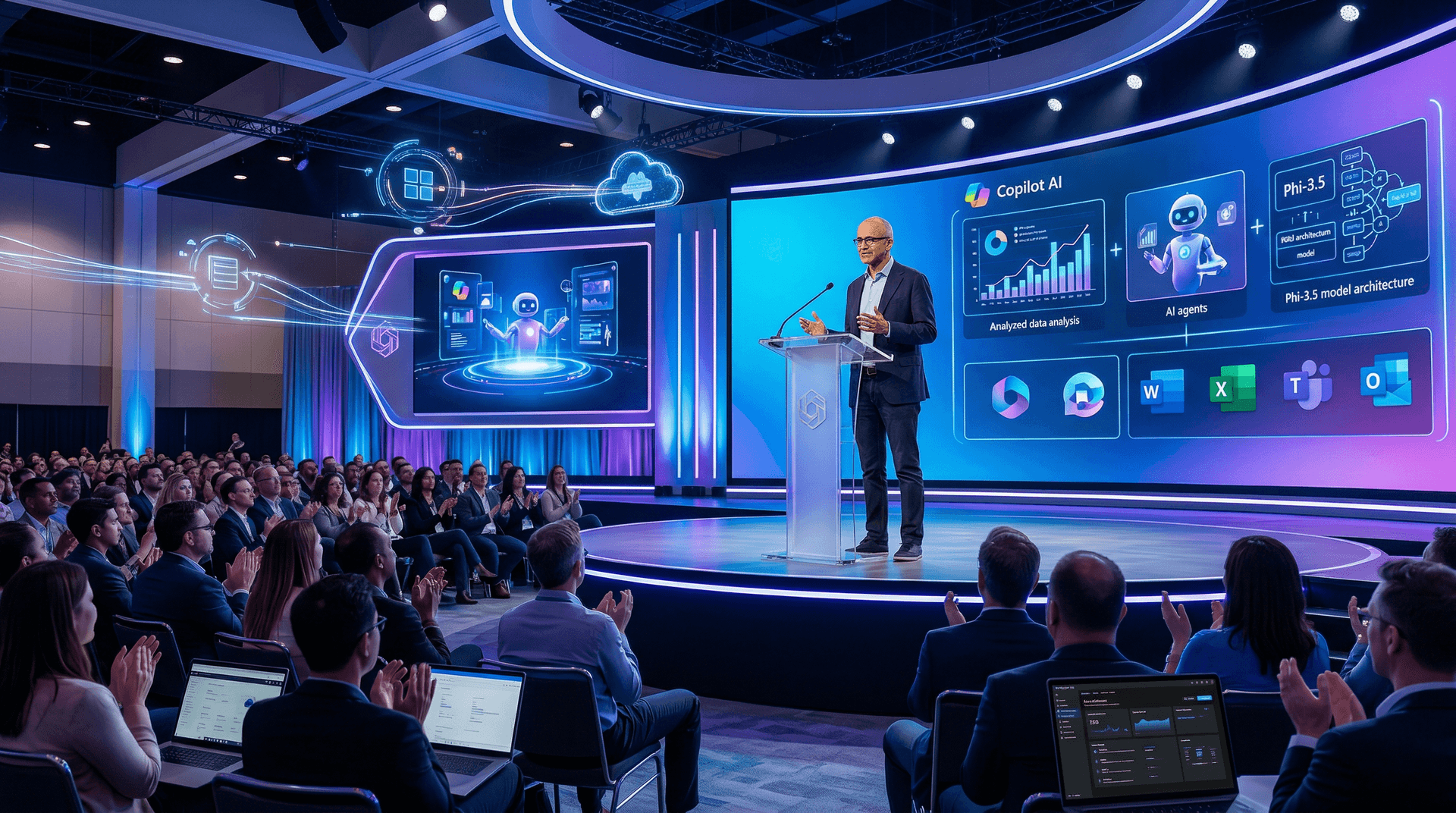
Microsoft's annual Ignite conference, underway in Chicago from November 18 to 21, 2024, has already delivered a flurry of software announcements centered on artificial intelligence. CEO Satya Nadella took the keynote stage on the first day to unveil Microsoft 365 Copilot Wave 2, a significant evolution of the company's flagship AI assistant. This update introduces specialized AI agents designed to handle complex tasks autonomously, marking a shift from reactive tools to proactive enterprise partners.
Copilot Wave 2: Empowering Knowledge Workers
At the heart of the announcements is Copilot Wave 2, rolling out to Microsoft 365 customers starting in December 2024. Unlike previous iterations that focused on basic content generation and summarization, Wave 2 emphasizes deep reasoning and action-taking capabilities. Key features include:
- Researcher Agent: This agent scours internal and external data sources to compile comprehensive reports. It can synthesize information from emails, documents, and web results, delivering cited insights without users needing to prompt extensively.
- Analyst Agent: Tailored for data-heavy workflows, it performs advanced analytics on Excel datasets, Power BI visuals, and more. Users can ask natural language questions like "What's driving our Q4 revenue dip?" and receive visualizations and recommendations.
Nadella highlighted how these agents reduce the time spent on rote tasks by up to 30%, based on early previews. "Copilot is no longer just a sidekick; it's becoming the chief of staff for every knowledge worker," he said.
Integration with existing Microsoft 365 apps is seamless. In Outlook, Copilot now drafts meeting briefs with action items. In Teams, it generates post-meeting recaps and assigns follow-ups automatically. For developers, Copilot Studio enters public preview, allowing no-code creation of custom agents grounded in organizational data.
Open-Sourcing Phi-3.5: Democratizing Small Language Models
Microsoft didn't stop at enterprise tools. The company open-sourced Phi-3.5 MoE (Mixture of Experts) models under the MIT license. These lightweight models, with 3.8 billion and 41 billion parameters, rival larger counterparts in performance while running efficiently on standard hardware.
- Phi-3.5-vision-instruct handles multimodal tasks like image captioning and visual question-answering.
- Optimized for edge devices, they power on-device AI in Windows Copilot+ PCs.
This move aligns with Microsoft's push for open AI innovation, following the Phi-3 family released earlier in 2024. Developers can now fine-tune these models for specific industries, from healthcare diagnostics to retail personalization.
Azure AI Foundry and Security Enhancements
On the cloud side, Azure AI Foundry was introduced as a unified platform for building, customizing, and managing AI apps at scale. It supports over 1,800 models from partners like Meta, Mistral, and Hugging Face, with built-in tools for tracing, testing, and prompt engineering.
Security remains paramount. Microsoft Security Copilot gains new agents for threat hunting and vulnerability management. Integration with Defender for Cloud Apps now uses AI to detect insider risks proactively.
Nadella also teased Windows AI experiences, including Recall enhancements (postponed earlier due to privacy concerns) and Live Translation in Paint—turning sketches into multilingual captions.
Implications for Enterprises and Developers
These announcements come at a pivotal time. With competitors like Google (Gemini updates) and OpenAI (o1 reasoning models) advancing rapidly, Microsoft is doubling down on its ecosystem lock-in. Over 230,000 organizations use Microsoft 365 Copilot, generating billions in revenue.
Critics note potential privacy pitfalls with agentic AI accessing vast data troves. Microsoft addressed this with Purview extensions, offering granular controls and audit logs. Compliance with GDPR and upcoming EU AI Act is baked in.
For developers, the deluge of tools—Copilot Studio, GitHub Copilot Workspace, and now Azure AI Studio—lowers barriers to AI adoption. A session demo showed a custom sales agent built in minutes, querying CRM data and scheduling demos via Teams.
Broader Industry Impact
Ignite 2024 underscores software's AI inflection point. Agentic systems, where AI acts independently, could automate 60-70% of office work, per McKinsey estimates. Microsoft's hybrid approach—cloud, edge, open-source—positions it to capture this shift.
Partnerships shone through: NVIDIA for GPU-accelerated Phi models, BlackBerry for Cylance AI security, and ServiceNow for Copilot integrations.
As the conference continues, expect deeper dives into SharePoint agents and Power Platform expansions. By November 21, Microsoft will likely preview Windows Server 2025, emphasizing AI ops.
Looking Ahead
Microsoft Ignite 2024 reaffirms the company's software supremacy in the AI era. Copilot Wave 2 isn't just an update; it's a blueprint for autonomous digital workplaces. Enterprises must weigh adoption speed against governance needs.
For tech leaders, the message is clear: AI agents are here, and they're rewriting productivity rules. Stay tuned for hands-on previews as Wave 2 deploys.
AM Lens News coverage from Chicago, November 20, 2024.
(Word count: 912)