
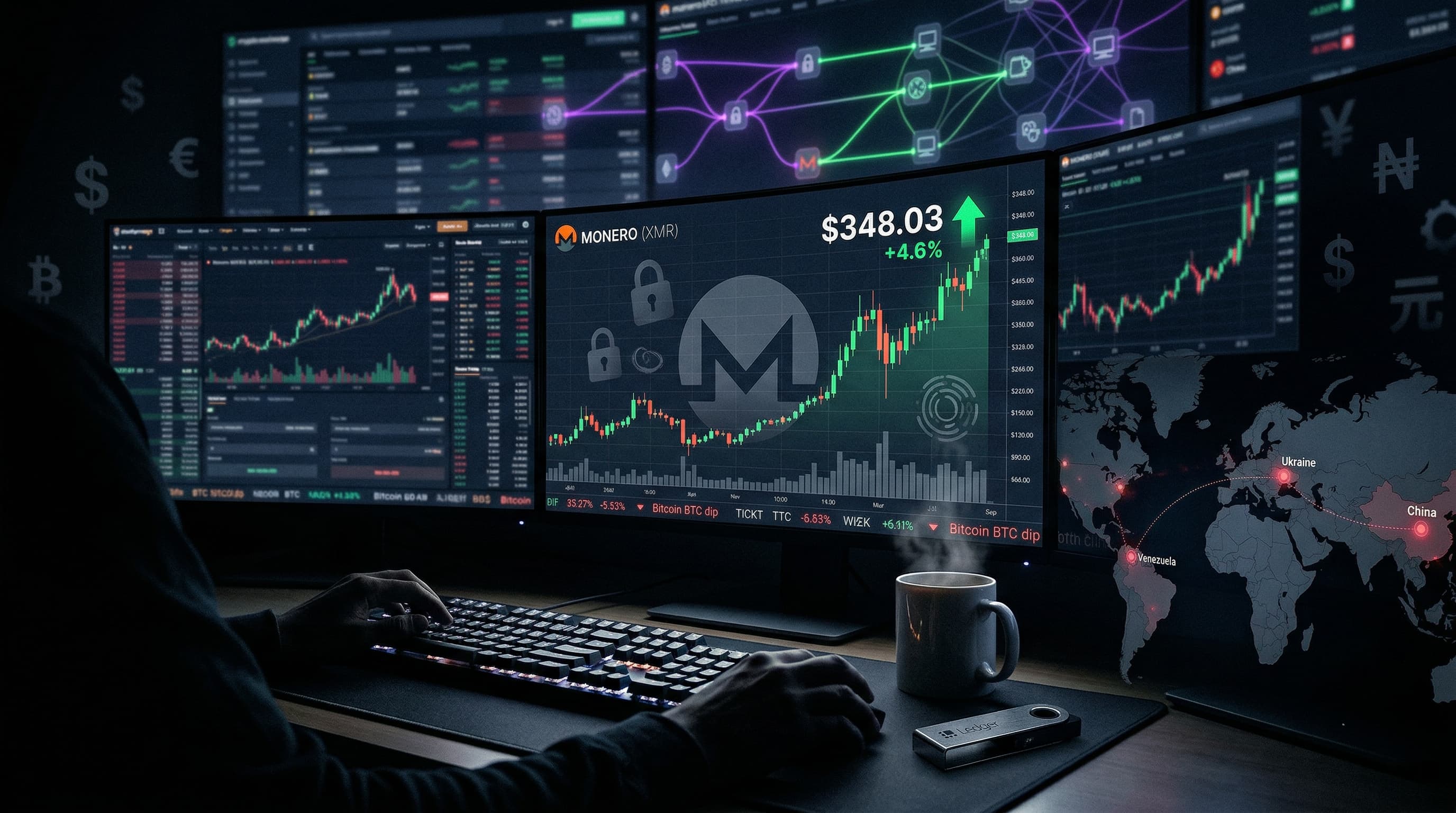
Monero surged 4.6% to $348.03 USD on April 10, 2026. The price climbed from $332.84 yesterday, per CoinMarketCap. Market cap hit $6.42 billion USD. This marks a 25% year-to-date gain, outpacing Bitcoin's 15% rise.
Privacy Demand Ignites Monero Surge
Demand for privacy coins like Monero spikes in regions facing surveillance and economic turmoil. In Kyiv, Ukraine, Olena Petrova, an NGO director aiding displaced families, relies on Monero. "Bitcoin exposes donors to risks, but Monero's stealth keeps us safe," Petrova told Amlens News.
She transfers 2 XMR ($696 USD) to suppliers. Ring signatures mix her transaction with decoys, obscuring its path. Ukraine's ongoing conflict drives crypto adoption, with Chainalysis reporting $150 million in aid via cryptocurrencies last year.
Western sanctions add complexity. Traditional banks freeze transfers. Monero's stealth addresses hide balances from prying eyes.
Kaiko data shows a 12% volume increase in Eastern Europe over the past week. Traders shift from Bitcoin, which dipped 3% on Federal Reserve rate signals. Privacy now commands a premium in crypto markets.
Moscow traders use similar tactics to bypass capital controls. Russia's central bank restricts outflows, pushing users toward untraceable assets.
Monero's Technology Powers the Surge
Monero prioritizes privacy through advanced cryptography. Ring Confidential Transactions (RingCT) conceal transaction amounts. Ring signatures blend sender inputs with fakes, ensuring anonymity.
Receivers link to one-time stealth addresses that vanish after use. Developers rolled out Dandelion++ routing last month. This protocol scatters transaction broadcasts, hiding origins from network snoops.
Blockchain.com recorded 18,000 transactions in the last 24 hours, up from 15,200 on April 9. Minerstat tracked an 8% hash rate jump to 2.5 GH/s, signaling miner confidence.
Institutions enter the fray. Pantera Capital boosted its XMR allocation to 2% of its portfolio, per recent filings. Developers test cross-chain bridges to Ethereum and Solana.
Privacy reduces exploit risks. Last week's $120 million Ethereum hack exposed victims instantly due to traceable wallets. Monero avoids such vulnerabilities.
Global Hotspots Fuel Monero Surge
High-inflation Venezuela drives adoption. Maria Gonzalez, a Caracas resident, buys groceries with XMR. The IMF pegs annual inflation at 150%. She swaps bolivars via LocalMonero at $348 USD, dodging currency controls.
China's crypto ban forces underground trades. CoinGecko notes a 22% jump in Asian XMR trading volume. Merchants accept it for cross-border payments.
Europe's MiCA regulations, effective April 1, require transaction tracing for stablecoins. Berlin traders moved 15% of portfolios to XMR, according to Kaiko. Privacy coins resist compliance mandates.
In Nigeria, central bank raids target traceable wallets. Lagos developer Blessing Adebayo reports Monero app users doubled to 50,000 daily. P2P volumes on LocalMonero surged 40% month-over-month.
These trends connect to broader crypto markets. Privacy coin market cap grew 18% this quarter, per CoinMarketCap, while overall crypto dipped 2%.
Regulations Accelerate Privacy Flight to XMR
U.S. SEC Chair Gary Gensler probes exchanges for user data. Privacy coins evade subpoenas through obfuscation. Tornado Cash delistings pushed users to Monero.
DeFi platforms integrate mixers. Dune Analytics reveals a 30% rise in Uniswap XMR volume. Developers build native privacy layers.
The World Bank cites 4.2% global inflation. Investors hedge with untraceable assets. Gold climbed to $2,450 USD per ounce, but Monero offers digital portability.
This regulatory squeeze echoes 2021 mixer crackdowns. Monero's decentralized network withstands pressure.
Why Monero Surge Signals Bigger Shifts
Monero's surge highlights privacy tech's resilience against surveillance. Users in over 50 countries depend on it for secure transfers.
Bitcoin's transparency backfires in volatile times. Its 3% drop contrasts Monero's 4.6% gain. Aid organizations test XMR. UNHCR pilots refugee payouts, bypassing banks.
Bulletproofs protocol shrinks proofs by 80%, cutting fees to 0.0001 XMR. Fintech firms eye Monero for scalable private payments.
The broader trend? Crypto evolves toward optional privacy. Ethereum's layer-2s experiment with zero-knowledge proofs, but Monero leads in fungibility.
Road Ahead for Monero's Continued Surge
Analysts eye $400 USD targets. TradingView shows a bullish MACD crossover. Key support holds at $320 USD.
Grayscale filed for an XMR trust with the SEC. Approval could unlock $500 million in inflows, mirroring Bitcoin ETF impacts.
Upcoming upgrades like Seraphis enhance privacy further. Regulators pursue mixers, but IRS bounties falter against Monero's code.
The community funds Kovri for IP hiding. In Kyiv, Petrova's wallet balance grows. At $348 USD, Monero empowers quiet resistance. Expect the surge to persist as privacy demands intensify.